After-Hours Trading: What It Is, How It Works
September 21, 2026
What is after-hours trading? How does it work? Learn about the rules, risks, and benefits of extended-hours trading.

Key takeaways
- Extended-hours trading allows investors to buy and sell stocks outside regular market hours (9:30 a.m. to 4 p.m. ET).
- On Schwab platforms, investors can trade pre-market or after-hours sessions, while thinkorswim offers 24/5 overnight trading on select securities.
- Unlike the regular session, extended-hours trading accepts only limit orders.
- Potential benefits include greater convenience and the ability to react quickly to after-hours earnings reports or other market-moving news.
- Potential risks include reduced liquidity, wider bid/ask spreads, and increased volatility.
After-hours trading is the buying and selling of stocks outside regular market hours (9:30 a.m. to 4 p.m. ET) and is part of the practice of extended-hours trading. The extended-hours market technically runs from Sunday at 8 p.m. ET through Friday at 8 p.m. ET.
Trading activity doesn't stop with the closing bell. Nearly every day, stocks make notable pre- or post-market moves in response to an earnings announcement or other market-moving news.
Extended-hours trading is bookended by two sessions: pre-market activity before the open and post-market activity after the close. On thinkorswim® platforms, select securities can also be traded overnight 24 hours per day, five days per week (24/5).
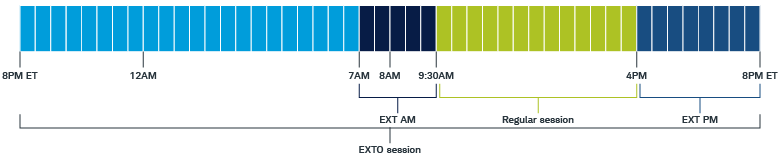
Trading outside regular hours is no longer a niche activity. In 2019, it accounted for about 5% of all U.S. equity share volume. By early 2025, per the New York Stock Exchange (NYSE), that share volume had more than doubled to over 11%, with more than 1.7 billion shares trading outside regular market hours each day.
Retail investors can participate in after-hours trading, but it's important to understand the guidelines, guardrails, and risks involved.
What is pre-market trading?
The pre-market session occurs before the market opens at 9:30 a.m. ET. At Schwab, clients can place orders as early as 8:05 p.m. the previous evening; those orders become eligible for execution between 7 a.m. and 9:25 a.m. ET on Schwab.com or Schwab Mobile. On thinkorswim, eligible securities can be traded around the clock (24/5) by choosing an EXTO order type.
Demand for pre-market trading has grown exponentially in recent years. Market-wide, volume has increased roughly 15-fold since 2019, compared to about 2.3-fold for after-hours activity. Early morning trading now accounts for more than 55% of all extended-hours volume, per the NYSE.
What is after-hours trading?
After-hours trading occurs after the markets close at 4 p.m. ET. Schwab clients can trade after hours from 4:05 p.m. to 8 p.m. ET on Schwab.com or Schwab Mobile, or around the clock (24/5) on thinkorswim by selecting a GTC (EXTO 24h) order type (see table for details).
Although after-hours action made up about 83% of all extended-hours trading in 2019, its share volume has since fallen to roughly 45% as pre-market activity has surged. The total number of shares traded after hours has continued to grow, however, as extended-hours trading overall gains in popularity.
How does extended-hours trading work?
Extended-hours trading is made possible by electronic markets, which are computerized services that match buy and sell orders. For example, if a trader places an order to buy 200 ZYX shares at $45, the system looks for an order to sell at least 200 ZYX shares at $45. If there is, the trade is executed; if not, the order won't be filled.
While commissions and settlement times during extended-hours trading are the same as those in the regular session, there are several differences to consider. Most notably, only limit orders are accepted. Other order types, such as market, stop, and stop-limit orders—and orders with special conditions like fill-or-kill, immediate-or-cancel, or all-or-none—can't be placed.
After-hours orders are good only for the session in which they're placed and don't carry over into future sessions. The exception to this is a good 'til canceled (GTC) order that includes extended hours. On Schwab.com and Schwab Mobile platforms, the order type appears as GTC + extended hours, and on thinkorswim, it is styled as GTC (EXT 13h). These orders remain active across the pre-market, regular, and after-hours sessions for up to 180 calendar days, or until they're filled or canceled.
Using a GTC + extended hours order may potentially give traders the opportunity to enter or exit a trade at their desired price, but it can also result in multiple executions to fill a single order, especially if the security is thinly traded.
Advantages of after-hours trading
There are two primary benefits of extended-hours trading:
- Convenience: Some traders' schedules don't allow them to place trades during the regular session. Extended-hours sessions allow them to review the latest news and quotes and potentially place trades at a more convenient time.
- Ability to react to news: Many companies release earnings after the close of the regular session. After-hours traders can respond right away by adjusting positions and potentially participating in price swings, rather than waiting for the next day's open.
Risks of extended-hours trading
While trading outside regular trading hours can have advantages, there are also unique risks:
- Uncertain prices: In the regular session, stock quotes are consolidated and represent the best available prices across all trading venues. In extended hours, prices may come from only one venue and may not reflect prices shown in other electronic trading systems.
- Lower liquidity: Because fewer shares generally trade after hours, there can be wide spreads between the bid (the highest price a buyer will pay) and the ask (the lowest price a seller will accept).
- Greater volatility: With fewer participants trading, a single order can move a security's price more than it might during regular hours, leading to sharper swings.
- Partial fills: A limit order may fill only in part (or not at all) before the session ends.
- No index value calculation: Index levels generally aren't calculated or disseminated after hours, which can pose a challenge for traders of index-tracking products. Professional traders may gain an edge here by using proprietary systems that quickly estimate index values based on individual stock prices.
Regular market vs. extended-hours and overnight sessions for equities
Below are some basic differences between regular and extended-hours trading. For more information, and specifics on accessing extended hours through Schwab platforms, visit our extended-hours hub.
- Regular trading sessions
- Pre-market, after-hours, and overnight trading sessions
-
Regular trading sessionsOrders can be placed at any time and will only be executed from 9:30 a.m. to 4 p.m. ET.Pre-market, after-hours, and overnight trading sessionsOrders in extended hours can be placed outside of regular market hours (9:30 a.m. to 4 p.m. ET) and are available for the following times.For orders placed on thinkorswim platforms:7 a.m. to 8 p.m. ET with five-minute closures before and after regular market hours.Overnight trading is available 24 hours per day, every market day, by choosing an EXTO order type. EXTO orders expire at 8 p.m. ET each day. For example, an EXTO order placed at 2 a.m. ET Monday morning would be active immediately and remain active from then until 8 p.m. ET Monday night. A trade placed at 9 p.m. ET Monday night would be active immediately and remain active until 8 p.m. ET Tuesday night.For orders placed on Schwab.com or Schwab Mobile:7 a.m to 8 p.m ET with five-minute closures before and after regular market hours.
-
Regular trading sessionsTrading occurs on exchanges like the New York Stock Exchange (NYSE) and Nasdaq and through a variety of venues, including market makers and other market centers.Pre-market, after-hours, and overnight trading sessionsSimilar to regular market sessions, trading occurs on exchanges like the NYSE and Nasdaq and through a variety of venues, including market makers and other market centers.
-
Regular trading sessionsMany order types and restrictions are accepted, including market, limit, stop-limit, all-or-none, etc.Pre-market, after-hours, and overnight trading sessionsOnly limit orders are accepted.
-
Regular trading sessionsAll order sizes are accepted.Pre-market, after-hours, and overnight trading sessionsFor pre-market and after-market trading sessions on Schwab.com, there is no maximum quantity on a single order.Overnight session orders are subject to limitations of maximum notional value of $2,000,000 OR maximum share quantity of 50,000 shares.Overnight session orders will also be rejected if the order is more than 10,000 shares AND has a $200,000 or greater order value.
-
Regular trading sessionsMany security types are available, including stocks, options, bonds, mutual funds, etc.Pre-market, after-hours, and overnight trading sessionsMost listed and Nasdaq securities are available in the extended-hours session.
-
Regular trading sessionsDifferent timing choices are available, including Day, GTC, IOC, and FOK.Pre-market, after-hours, and overnight trading sessionsPre-market, after-hours, and overnight session order types are only good for the particular session in which they are placed. Seamless orders that participate in pre-market, regular market, and after-hours trading are available to be placed GTC.Note that GTC EXTO must be chosen to place overnight trading on the thinkorswim platform.
-
Regular trading sessionsIn general, higher trading activity means more liquidity and a greater likelihood of order execution.Pre-market, after-hours, and overnight trading sessionsLower trading activity may result in lower likelihood of order execution, wider spreads, and greater price fluctuation.
-
Regular trading sessionsThe quotes you receive are consolidated and represent the best available prices across all trading venues; market makers and specialists work to ensure clients get the best available buy or sell prices.Pre-market, after-hours, and overnight trading sessionsQuotes and fills are not consolidated and represent the current prices available through the market. As a participant in the extended-hours trading network, the market may also offer access to prices available in other participating markets, but not all venues are open for extended-hours trading. Best execution is not guaranteed.
Bottom line: Extended hours offer greater flexibility, but carry additional risks
Trading before and after the regular session—through pre-market and after-hours functions on any Schwab platform and 24/5 overnight trading on thinkorswim—gives investors more ways to manage positions and react to news. But the trade-offs are notable: Only limit orders are accepted, liquidity will generally be thinner while spreads may be wider, and volatility may be more pronounced. Understanding the guardrails can help traders determine whether trading outside regularly scheduled market hours is a smart addition to their regular strategy.
After-hours trading FAQs
What stocks can be traded after hours?
Any listed equity available during Schwab's pre-market and after-hours sessions on Schwab platforms is available for trading. The overnight (24/5) session, available only on thinkorswim, covers a broad list: all stocks in the S&P 500® Index, Nasdaq-100®, and Dow Jones Industrial Average®, plus more than 600 ETFs. In any given session, however, a specific security may not trade if there is limited trading interest. On thinkorswim, there is a public watchlist listing all 24-hour trading eligible securities (see below).
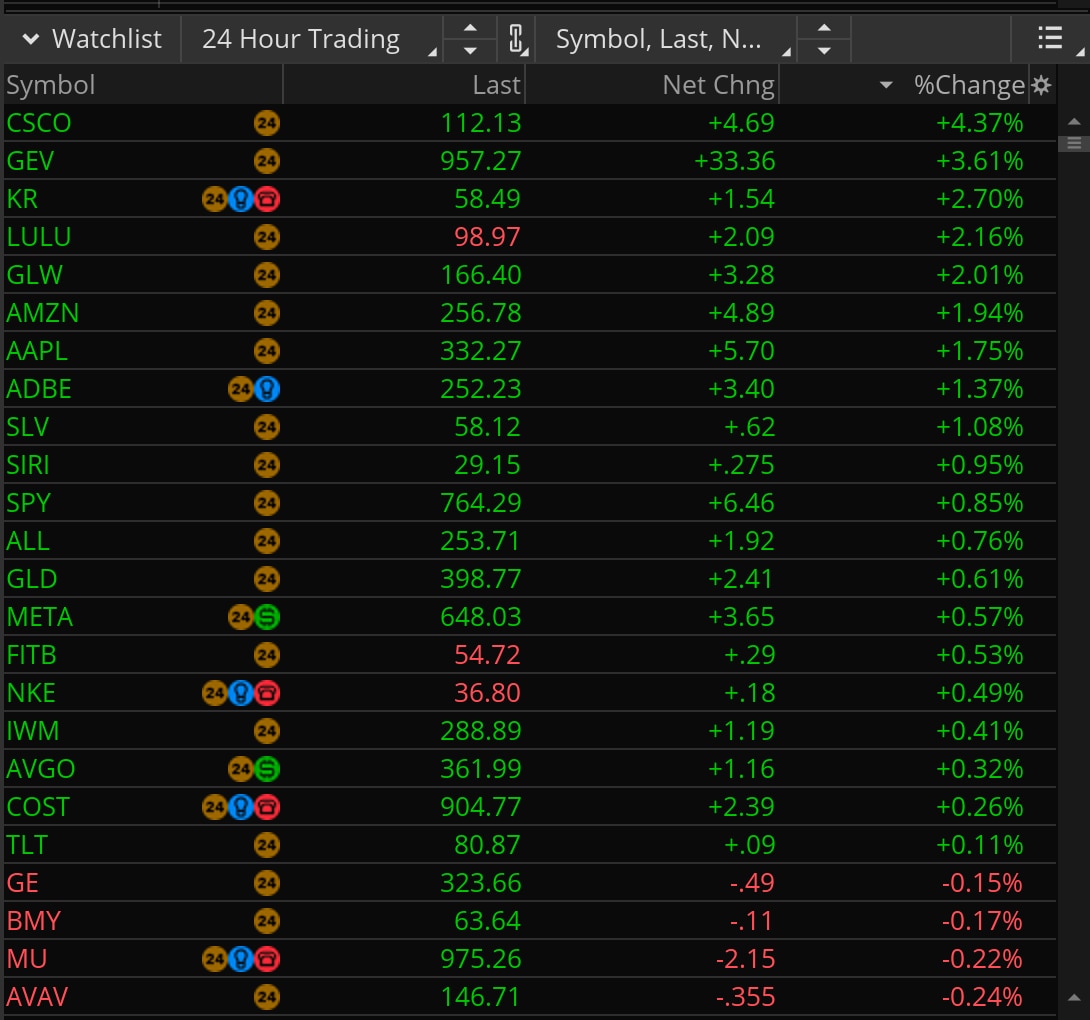
Source: thinkorswim platform. Data as of 9/14/26.
How do holidays impact extended-hours trading?
When the market closes for a half day at 1 p.m. ET, extended hours trading concludes at 5 p.m. ET. When the market is closed for a full day, trading ends at 8 p.m. ET on the calendar day before the holiday and reopens at 8 p.m. ET on the holiday itself. If the holiday falls on a Friday, trading resumes at 8 p.m. ET on Sunday.
Are OTC stocks available for extended-hours trading?
No. OTC securities aren't available to trade in the extended-hours or overnight sessions, largely due to heightened risk, reduced liquidity, and volatility that can often be more pronounced in OTC stocks.
Is shorting stock available in extended-hours trading?
Shorting is available during extended hours but not overnight (between 8 p.m. and 7 a.m. ET).
How is after-hours trading different on Schwab platforms versus thinkorswim?
24/5 overnight trading is exclusive to thinkorswim platforms, due to the specialized technology and systems that enable it. Schwab will continue to evaluate the technical feasibility of extending this feature to Schwab platforms in the future.
Can I talk to someone if I have more questions about extended-hours trading?
Yes, call a Schwab trading specialist at 888-245-6864 for help with extended-hours and 24/5 trading.
Trade stocks and ETFs around the clock with Schwab
Take advantage of trade opportunities even when exchanges are closed. Learn more.