Looking to the Futures
Oats Futures stabilize after front-month contracts roll
July 2, 2026
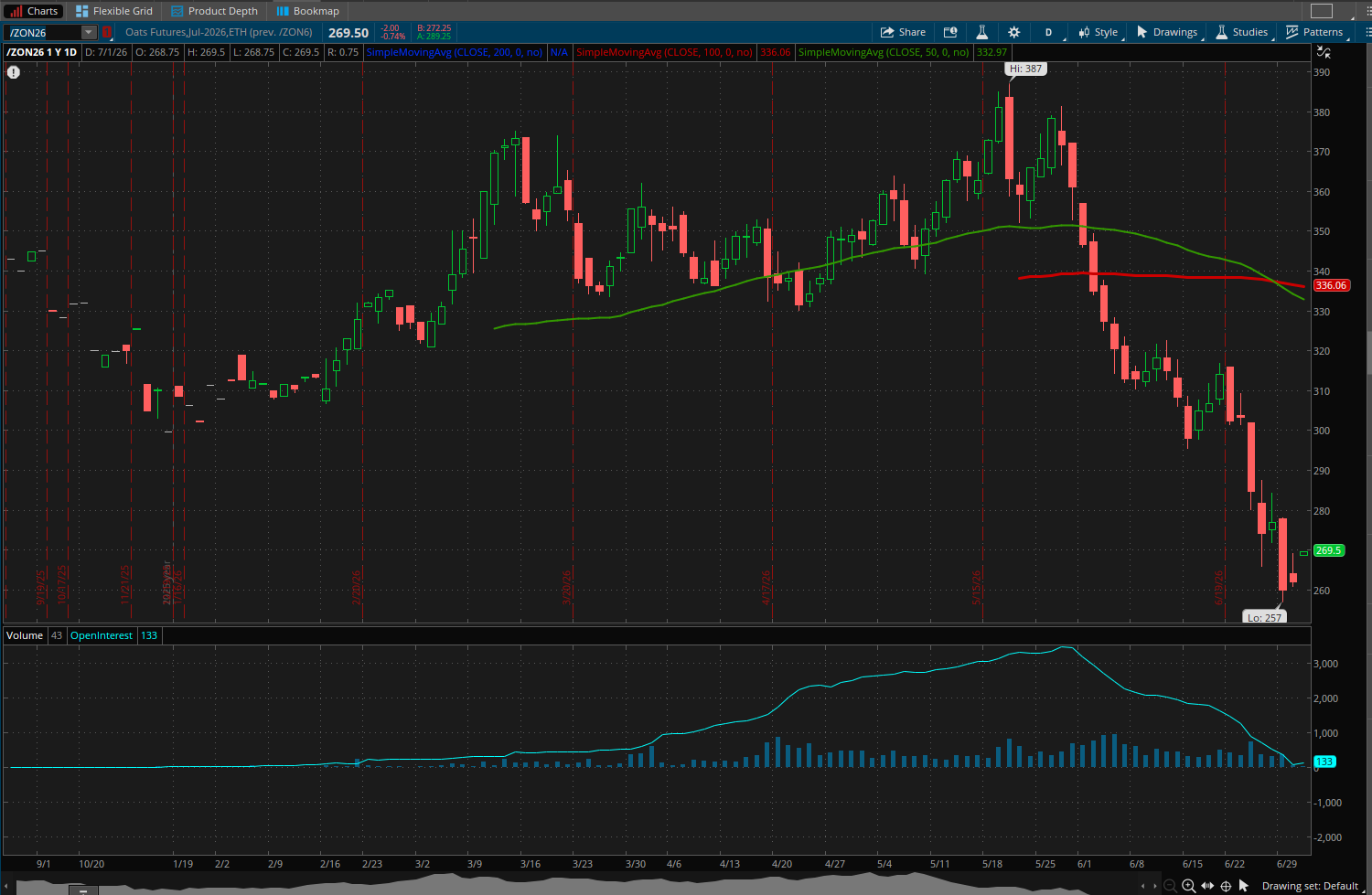
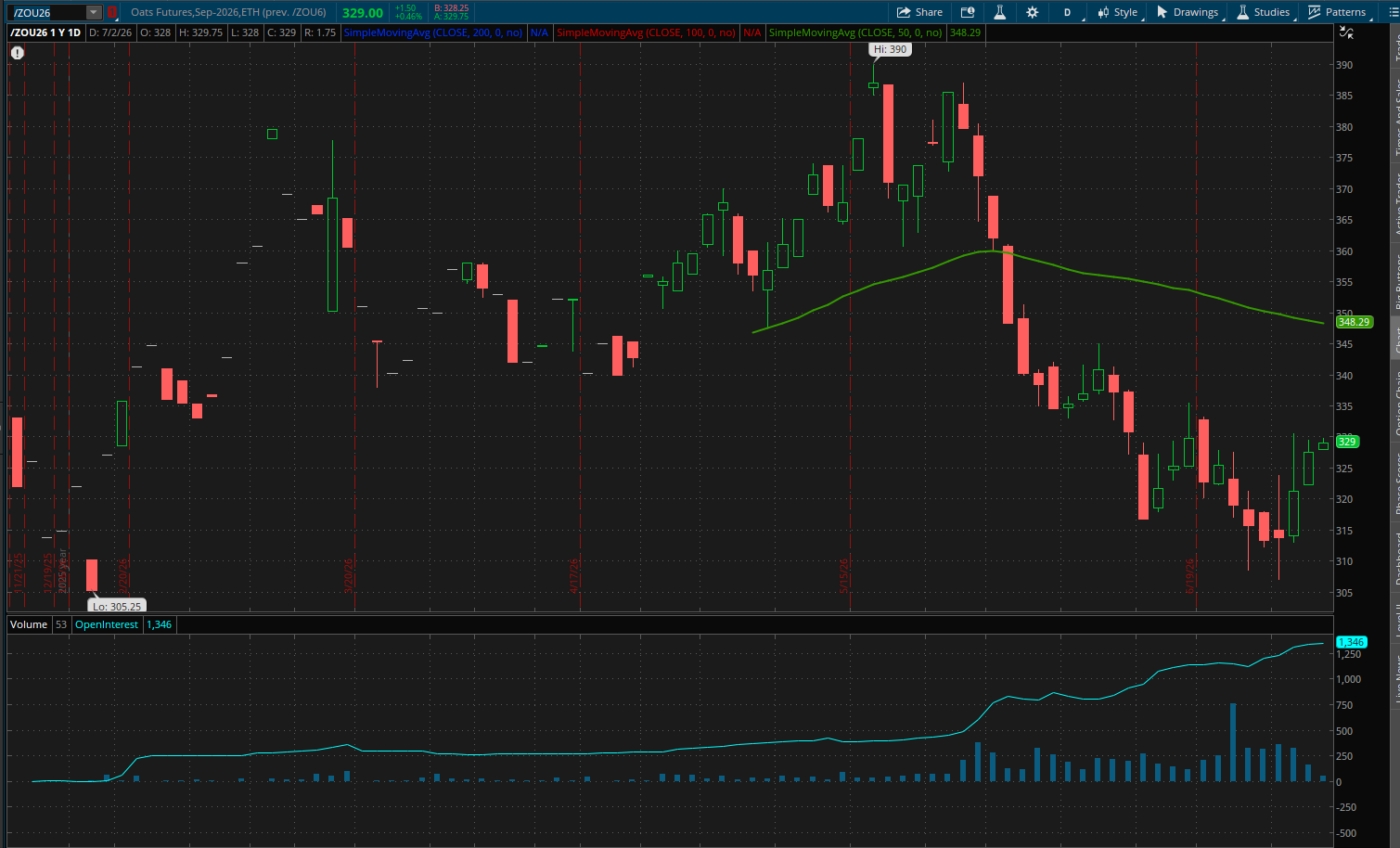
September Oat Futures (/ZOU26) have found a consolidative price floor as ample supply meets subdued demand.

Live Cattle Futures for the month of October (/LEV26) were lower on Tuesday, settling at 217.22 per hundredweight (cwt). While October Feeder Cattle futures moved higher settling at 330.90 p/ cwt or up 1.63 p/ cwt. Feeder and Live cattle prices remain well off the historical high for Feeder being from June 26 of 381.86 p/ cwt and Live cattle highs of 256.66 from May 1. Confirmed negotiated sales of dressed purchases were reported to be 1,466 so far this week. The last established market test in Nebraska was 345-350. For live cattle, the last market test was last week from 220-223.
The September 25th USDA Cold Storage showed that cold storage was up 1% from the prior month and up 8 percent from last year and beef in freezers were up 2% from prior month and up 5% from the prior year. The increase in cold storage stocks could provide some resistance for consumers, helping show that supply is outpacing the demand for the product or the product is backing up in the distribution chain. Immigration and Customs Enforcement (ICE) operations have provided a disruption in the short term according to the Texas Cattle Feeders Association, Kansas Livestock Association, and Oklahoma Cattleman's Association. Reports of delays in shipping thousands of cattle to processors and workforce disruptions to supply chains such as dairies, feedyards, transportation hubs as well as feed and grain companies. Higher oil prices drive increased operating experience for cattle producers. Rising diesel prices have pushed cattle freight up by $1 to $1.50 per loaded mile, steepening location discounts for cattle located far from major feeding centers.
U.S beef imports forecasted to rise 16% year over year from 2025. Market volatility surged following the administration's announcement to temporarily eliminate tariff-rate quotas (TRQ) for the "Others" beef-import category (primarily Brazil, along with Paraguay and Nicaragua) for September through November. The rule allows up to 100,000 metric tons (220 million lb.) per month out-of-quota. CattleFax estimates actual import volume could expand by an additional 50 to 75 million lb. per month in October and November from Brazil.
Fed cattle slaughter remains historically low, leading to lower beef production forecasts for 2026 and 2027. According to the USDA Economic Research Service, cattle prices continue to decline from spring highs, reducing price expectations through next year. The expansion of a tariff-free quota for lean beef from September through November is expected to boost U.S. imports in late 2026, and beef export projections are raised slightly for both 2026 and 2027.
Light Sweet Crude Oil futures (/CL) have traded in a wide range since June 30, moving between 67.04 and 93.50. Prices have since pulled back and are trading below the 9-day, 50-day, and 100-day simple moving averages (SMA), while remaining above the 200-day (SMA), which recently acted as support after crude briefly moved below it and reached a low of 67.04 on July 2. From a short-term trend perspective, the 9-day (SMA) crossed above the 50-day simple moving average on July 27, which may be viewed as a bullish technical development. However, the 20-day simple moving average and 21-day exponential moving average remain below the 50-day (SMA), suggesting the broader technical picture remains mixed. Volatility has eased from mid-month levels, falling from a high near 175% to roughly 69%. Momentum has also cooled, with the relative strength index declining from near 70 to 52.6. With the RSI only slightly above 50, momentum appears more neutral and may suggest crude is beginning to stabilize.
New Products
New futures products are available to trade with a futures-approved account on all thinkorswim platforms:
- Ripple (/XRP)
- Micro Ripple (/MXP)
- 100 OZ Silver (/SIC)
- 1 OZ Gold (/1OZ)
- Solana (/SOL)
- Micro Solana (/MSL)
Visit the Schwab.com Futures Markets page to explore the wide variety of futures contracts available for trading through Charles Schwab Futures and Forex LLC.